58% of Surveyed Borrowers Still Owe for Last Year’s Holidays, but Shoppers Are Finding Ways to Celebrate

Lingering debt and rising living costs strain household finances as the holidays approach. Shoppers are responding by adjusting how much they spend, what they buy, and how they pay for gifts.

Shannon Martin
Writer: Shannon MartinEconomic Analyst and Licensed Insurance Agent

Qualifications:
  • Licensed property and casualty insurance agent

  • 20 years in the P&C insurance industry


An economic analyst, and personal finance writer, Shannon has appeared in the New York Times, Wall Street Journal, and more.

Nick Versaw
Editor: Nick VersawSenior Managing Editor

Qualifications:
  • 10+ years writing and editing insurance content

  • Published in Washington Post, LA Times, and more


Nick leads Compare.com's editorial team in creating helpful, easy-to-understand content about insurance and personal finance.

Published

Why You Can Trust Compare.com: At Compare.com, it’s our mission to find simple ways to help our customers save money on the things they need. While we partner with some of the companies and brands we talk about in our articles, all of our content is written and reviewed by our independent editorial team and never influenced by our partnerships. Learn about how we make money, review our editorial standards, and reference our data methodology to learn more about why you can trust Compare.com.

For many Americans, the holiday season is a time to celebrate, reconnect with loved ones, and carry on family traditions. But it’s also when holiday expectations collide with financial realities.

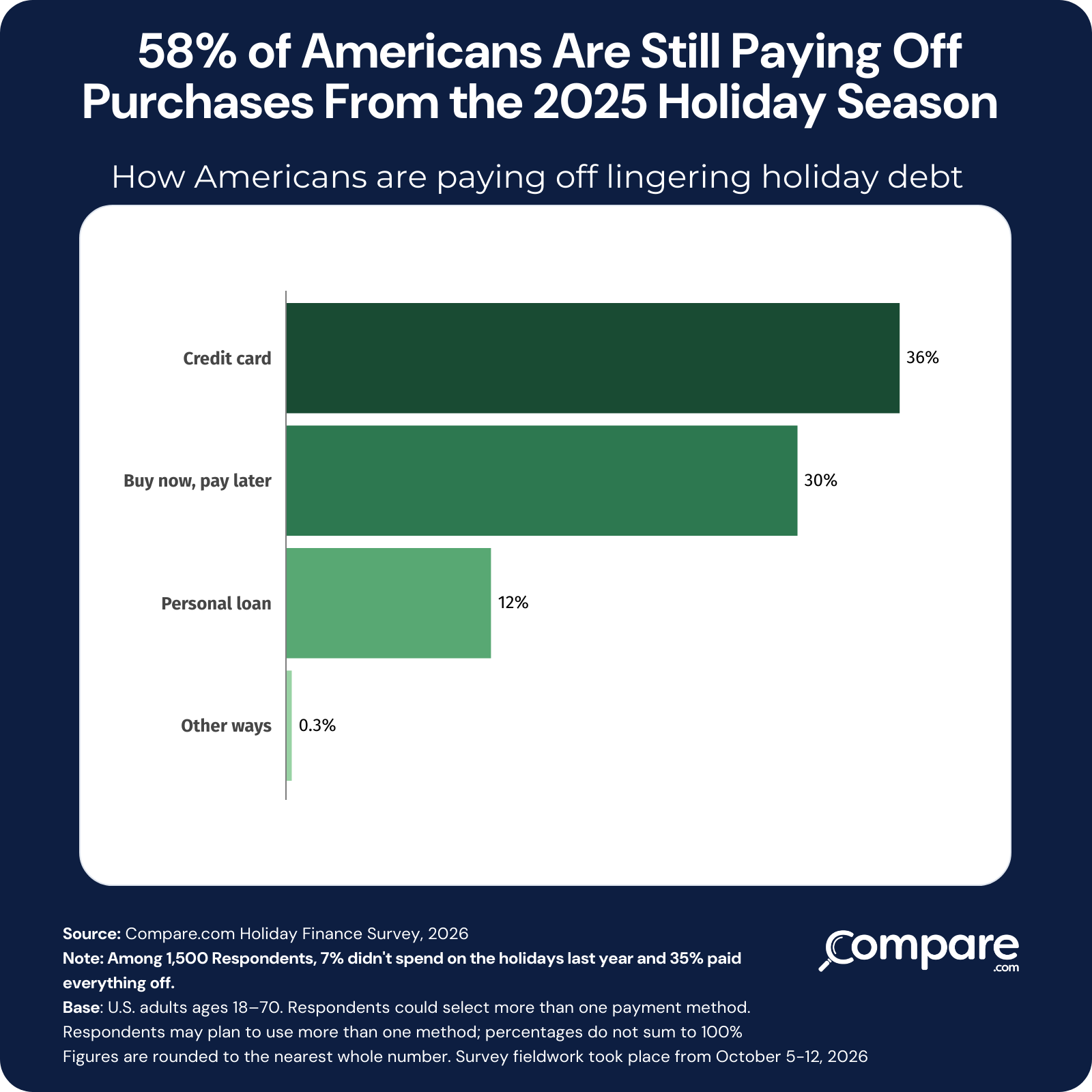
Years of rising prices and modest income growth have made everyday necessities harder for many Americans to afford. A Compare.com survey of 1,500 U.S. adults with outstanding debt found that 58% are still paying off holiday purchases from last year.

That lingering debt comes as household budgets face continued pressure. Grocery prices grew nearly 32% between February 2020 and September 2026, according to U.S. Bureau of Labor Statistics (BLS) data accessed through the Federal Reserve Bank of St. Louis’ Federal Reserve Economic Data (FRED) database.[1] Meanwhile, median household income grew just 4.6% between 2020 and 2025 after adjusting for inflation.[2]

Yet debt isn’t stopping Americans from spending on the holiday. We found that 95% of surveyed borrowers still plan to buy gifts this holiday season, balancing seasonal spending against existing financial obligations.

This year, Americans plan to stretch their dollars through a mix of borrowing, selective cutbacks, and creative shopping strategies. One in 4 holiday shoppers will turn to secondhand gifts to find the most affordable prices. And 41% plan to reduce or eliminate spending on holiday decorations. Children, however, remain a priority. Nearly 2 in 3 shoppers (62%) plan to spend at least as much on children’s presents as last year, but 9% plan to eliminate gifts for adults.

Key Findings

  • Nearly two-thirds of holiday shoppers (64%) plan to use buy now, pay later (BNPL) loans as one way to pay for gifts this year.

  • Approximately 2 in 5 holiday shoppers (41%) plan to cut back on or eliminate gifts for adults, compared with 27% for children’s gifts.

  • Seven in 10 borrowers with student loan debt (70%) say they will spend less on gifts this year, with 40% stating “a lot less.”

  • Among planned holiday spenders, 44% are shopping early, 42% are waiting for Black Friday or Cyber Monday deals, and 25% are buying secondhand.

  • On average, surveyed borrowers plan to spend $666 on gifts this year. About 1 in 5 (21%) say their holiday budget is lower this year compared to last year.

Nearly 3 in 5 Surveyed Borrowers Are Still Paying for Last Year’s Holidays

For many households, last year’s holiday spending never really ended.

While 58% of surveyed borrowers are still paying off purchases from the 2025 holiday season, more than 1 in 3 Americans carrying debt (36%) are paying off last year’s purchases on credit cards. Only 1 in 8 are still making personal loan payments, which typically carry lower interest rates than credit cards.

The type of financing shoppers choose can affect the total cost of their holiday purchase due to fees and interest. Based on the average APRs shown below, a $100 balance carried for one year with no payments or added charges would accrue nearly twice as much interest on a credit card as on a personal loan.

What Financing Costs for Every $100 in Spending

Payment Method
APR
Repayment Period
Added Interest
Total Paid
Short-term BNPL0%6 weeks$0.00$100
Long-term BNPL26%12 months$14.64$114.64
Credit card22.36%12 months$12.52$112.52
Personal loan11.90%12 months$6.56$106.56
Disclaimer: Costs assume on-time payments and no fees. APRs use Fed benchmarks and PayPal’s 26% BNPL example, not a market average. Interest-bearing balances are modeled over 12 months, using a 24-month rate benchmark for personal loans.

But the growth of buy now, pay later (BNPL) loan debt is particularly noteworthy. Our Compare.com survey shows that 30% of surveyed borrowers are still making BNPL payments on some of their 2025 holiday purchases.

BNPL is a fast-growing form of short-term credit, typically offered with no credit check and 0% financing. The share of U.S. households carrying BNPL debt rose from 7% in 2022 to 12% in 2025, according to the Federal Reserve.[3]

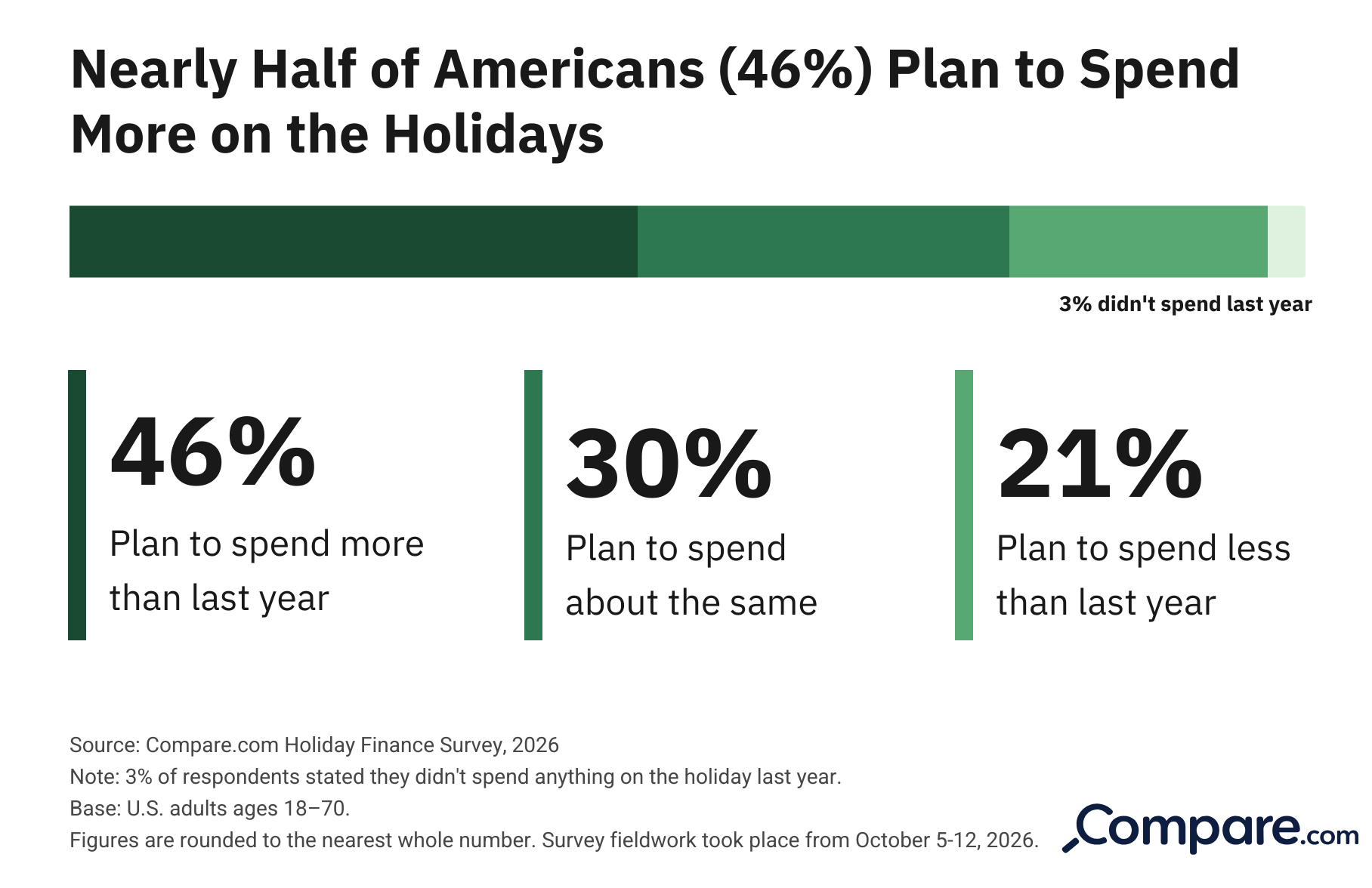
Even as many continue to pay for last year’s holidays, 46% of Americans carrying debt plan to increase their holiday budgets this year. With inflation and tariffs pushing up the cost of many gifts, spending more doesn’t necessarily mean buying more. For shoppers financing their purchases, interest could drive the final cost even higher.
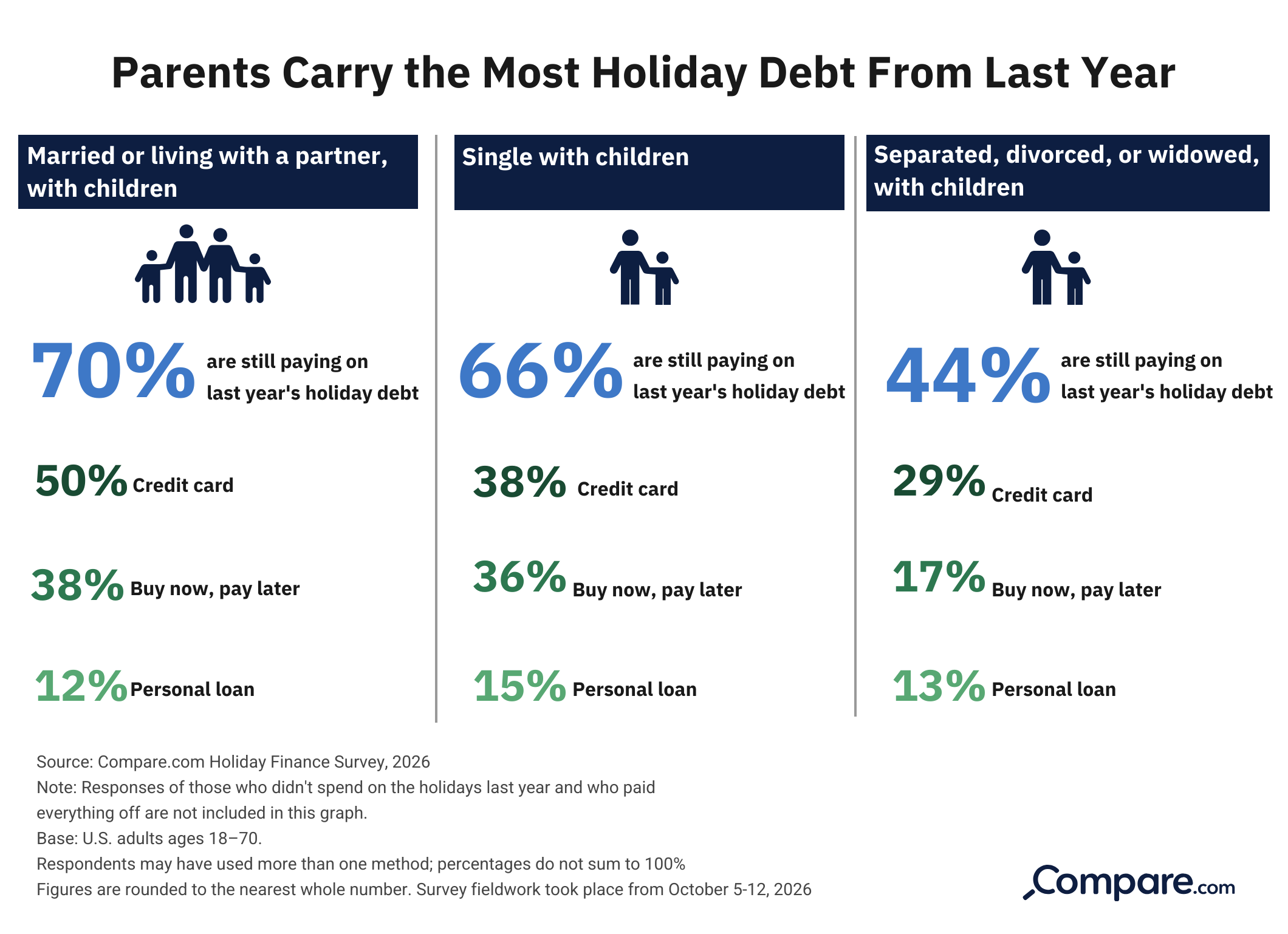
70% of married or partnered parents still carry holiday debt

Parents carry more holiday debt than non-parents. Nearly two-thirds (64%) are still paying off last year’s purchases, compared to about half (51%) of non-parents. The added financial demands of celebrating with children often extend gift-giving to teachers, caregivers, and school parties.

Compare.com also found that married or partnered parents reported more lingering holiday debt (70%) than single parents (66%), but that alone doesn’t mean they’re struggling more financially. Households with two adults may have more combined income and greater borrowing capacity to support that debt.

64% of Holiday Gift Givers Plan to Use Buy Now, Pay Later

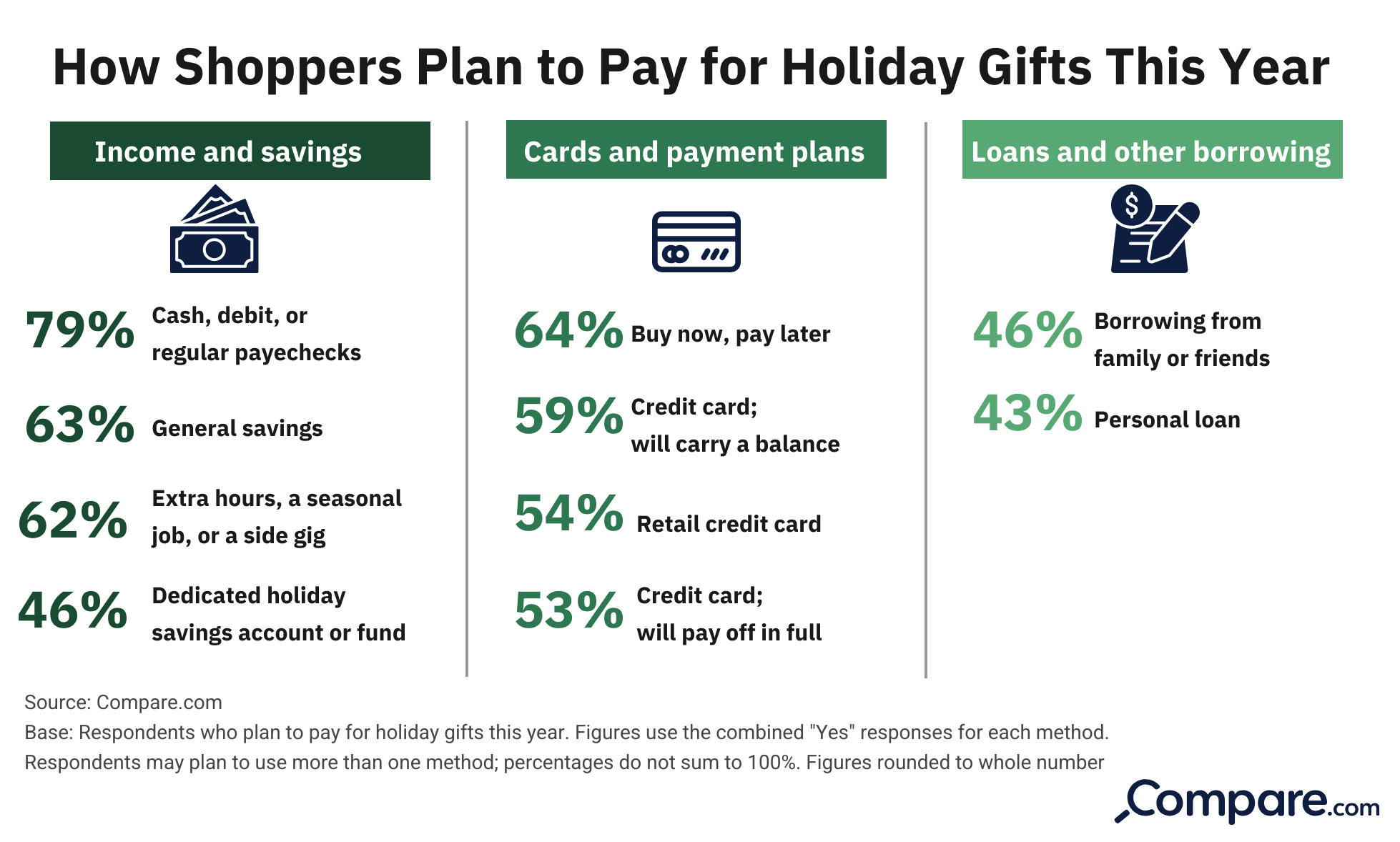
Of surveyed borrowers who plan to buy gifts this year, 79% expect to pay for at least some of them using cash, debit, or their regular paychecks. But that’s not the only way gift-givers plan to finance their holiday fun.

Nearly two-thirds of gift-shoppers (64%) plan on using BNPL, including 24% who will be first-time BNPL users. Taking out several of these loans can create loan stacking, making payments harder to keep track of and leading to fees for missed payments. Our survey found that more than half of BNPL users (59%) have missed a payment, and 26% have missed more than one.

Keep late fees from adding to holiday costs

Some BNPL providers may charge up to $8 per missed payment, while credit card late fees can reach $40 or more. Personal loan fees vary by lender. To avoid added costs, shoppers should check payment dates against their pay schedules, set reminders or automatic payments, and make sure they have enough money to cover each payment alongside their regular expenses.

Credit cards remain one of the most common options for gift-givers, with nearly 59% planning to carry a balance. Holiday borrowing would add to already elevated national credit card balances, which reached $1.26 trillion in the second quarter of 2026, up $54 billion from a year earlier, according to the Federal Reserve Bank of New York.[4]

Among shoppers planning to carry a balance, about 1 in 5 (21%) say they planned to do so for the first time. Shoppers with household income above $90,000 per year are 35% more likely than shoppers overall to say they’ll carry a balance for the first time this season, at 28%.

Slightly more than half of gift-givers (54%) plan to use retail credit cards to pay for holiday gifts this year, with 20% doing so for the first time. While retail cards typically offer holiday discounts and less stringent approval requirements, they often have annual percentage rates (APRs) nearing 30%, which can make them more challenging to pay down.

During the holiday shopping season, gift-givers may encounter store-card deferred interest promotions promising no interest if borrowers pay in full by a certain date. But if they leave any promotional balance unpaid past the deadline, they could owe interest retroactively on the entire purchase amount.

Most gift-givers (58%) say they expect to finish paying off what they borrowed for this year’s holiday gifts by spring 2027. We found that more than 3 in 5 borrowers (62%) who plan on buying gifts this year are taking on a second job or working more hours.

Shoppers May Spend More This Year Without Buying More

Americans carrying debt plan to spend $666 this year on gifts, more than they expect to spend on travel ($608) and holiday meals and gatherings ($465). While 21% of surveyed borrowers say they plan to spend less on gifts this year than last year, nearly half (46%) say they increased their gift budget.

Our findings suggest that Americans with debt are being selective about where they cut back, prioritizing some holiday expenses over others. Decorations are taking the biggest hit, with 41% of surveyed borrowers planning to reduce or eliminate spending on them, including 13% who intend to cut them out entirely. Holiday events and outings, such as shows and other activities, are also facing cuts, with 4 in 10 planning to spend less.

Nearly 1 in 4 borrowers surveyed (23%) plan to reduce their travel budgets, while 15% say they’ll skip holiday travel altogether. Cutting back on travel could free up money for gifts and other celebrations, particularly as transportation costs continue to rise. Airline fares increased 22.4% over the past year, while gasoline prices jumped 34.2%, making both flights and road trips more expensive.

Higher Prices Push More Than 2 in 5 Holiday Shoppers to Borrow

When asked to select all their reasons for borrowing, shoppers most often cited higher prices than last year (42%) and income that hasn’t kept pace with rising costs (37%).

One in 5 shoppers cite the strain of their car payments as a reason for borrowing. But the car payment is only part of the burden. Americans also have to find room in their budgets for an average of $5,851 in hidden car ownership expenses before adding loan payments.

That includes car insurance, which averages $2,243 per year, according to Compare.com rate data. Car insurance prices have risen nearly 47% since February 2020, according to the BLS’ Consumer Price Index.[5] Add in monthly auto loan payments, and transportation costs can leave less room for holiday spending.

Avoiding family disappointment is part of their borrowing decision

Emotions can influence shopping decisions, and family stress, gift expectations, and financial strain can make it harder to stick to a budget. Among holiday shoppers planning to use credit or borrow for gifts, 24% said it’s because they don’t want to disappoint their kids or family.

Inflation increased 3.7% between September 2025 and September 2026, according to data from the BLS. Toys alone increased 6.6% in the same time period.[6] That said, gifts for children appear to be the top priority and the least likely to face cuts among the seven holiday spending categories surveyed.

Nearly 1 in 3 shoppers (32%) plan to cut back on spending on gifts for adults, with an additional 9% planning to completely eliminate adult gift-giving. Around 22% plan to reduce spending on children’s gifts, and nearly 5% plan to cut gifts for children entirely.

As Gift Prices Rise, 41% of Shoppers Trim or Eliminate Gifts for Adults vs. 27% for Kids

Gift Type
Relevant Consumer Price Index (CPI) Category
Unadjusted Percent Change, Sept. 2025–Sept. 2026
ToysToys+6.6%
ClothingApparel+3.4%
CandyCandy and chewing gum+7.7%
Computers, tablets, and smart speakersComputers, peripherals, and smart home assistants+9.7%
SmartphonesSmartphones-9.9%
JewelryJewelry and watches+11.8%
BooksRecreational books-0.7%
Bikes and scootersSports vehicles, including bicycles+6.2%
Beauty and personal care productsCosmetics, perfume, bath, nail preparations, and implements+1.4%
Alcoholic beveragesAlcoholic beverages+1.4%
Disclaimer: U.S. Bureau of Labor Statistics, CPI, September 2025 to September 2026. BLS didn’t collect October 2025 data due to a government shutdown, so October 2026 year-over-year changes aren’t available for most categories.

Early Shopping, Sale Hunting, and Secondhand Finds Help Shape the Season

Even with tight household budgets, Americans are finding ways to keep holiday traditions alive.

Some shoppers will use credit cards or take out loans as a strategic, money-saving device. Just over 1 in 4 gift-givers (27%) said they want to earn rewards, points, or cash-back benefits, while 19% said it’s to take advantage of 0% interest.

Rising costs for everyday essentials are leaving less room for discretionary spending, even among households typically considered financially comfortable. Flexible payment options offer shoppers a way to spread out holiday expenses and fit additional holiday costs into tight budgets.

Holiday shoppers earning more than $90,000 were 41% more likely than shoppers overall to cite 0% interest or promotional offers as a reason for borrowing and 34% more likely to cite rewards, points, or cash back.

With affordability top of mind, many shoppers will turn to familiar strategies to save on holiday gifts, with 44% shopping early and 42% waiting for Black Friday or Cyber Monday deals. Others plan to turn to technology to help them save, with 4 in 10 saying they’ll use price-comparison sites or apps and 2 in 10 planning to use AI tools.

Some shoppers are prioritizing affordability by choosing less expensive brands or store-name brands (32%) or buying secondhand gifts (25%) instead of higher-priced alternatives.

How to Navigate Personal Loans, Credit Card Debt, and Student Loans This Holiday Season

The type of debt consumers take on matters and can affect how much they ultimately spend. Credit cards, personal loans, and BNPL plans have different interest rates, fees, and repayment schedules. Before borrowing, shoppers should calculate the total cost and determine how the payments will affect their budgets in the months ahead.

Set realistic expectations

Parents can reduce some of the pressure surrounding gift-giving by involving children in age-appropriate conversations about money. Explaining spending limits before shopping begins can help set realistic expectations without taking away from the holidays.

Set spending and payment goals ahead of time

Our survey found that 7 in 10 student loan borrowers say their debt affects how much they can spend on gifts this year, with 40% planning to spend significantly less. Potential changes to monthly payments could make additional holiday debt harder to manage in 2027. For all holiday shoppers, a realistic spending plan starts with accounting for regular expenses, an affordable monthly repayment plan, and a clear deadline for paying off purchases.

Paying off your credit card balance in full by the due date can help you avoid paying interest, but that isn’t a viable option for many shoppers this year. If you plan to carry a balance for several months, comparing your credit card’s borrowing cost with personal loan offers can help you find a repayment plan that fits your budget and costs less overall.

For example, paying off a $2,000 holiday purchase over 12 months would cost approximately $250 in credit card interest, compared to $131 on a personal loan at those rates, assuming no fees.

Cost Factor
Credit Card
Personal Loan
Interest rate22.36%11.90%
Monthly payment$187.54$177.60
Total interest over 12 months*$250.43$131.25
Total repayment$2,250.43$2,131.25
*Interest calculations assume 12 equal monthly payments, fixed rates, and no additional charges.

Personal loans typically carry lower interest rates than credit cards. In August 2026, credit card accounts accruing interest had an average rate of 22.36%, nearly double the 11.90% average for 24-month personal loans, according to the latest Federal Reserve data.[7]

At first glance, a personal loan’s lower APR may seem like the better option. But borrowers also need to examine the loan’s repayment terms and origination fees (to see how much cash they will actually receive) and understand the total repayment costs. Consider the following factors before deciding what type of borrowing you’ll use this holiday season:

  • Compare APRs: Check your credit card’s APR against actual loan offers, not just advertised rates.

  • Compare prequalified loan offers: Check rates and terms from multiple lenders. Prequalification typically uses a soft credit inquiry that won’t affect your credit score. After narrowing down the options, a formal application may trigger a hard inquiry, which can affect your credit.

  • Check for fees: Look for origination fees, late payment charges, and prepayment penalties.

  • Know how much money is available: Find out how much money you will get after deducting any loan fees.

  • Review monthly payments: Make sure payments fit your budget after regular expenses.

  • Set a payoff date: Choose a realistic repayment timeline and consider how a longer term affects interest costs.

  • Avoid interest when possible: Use cash or money saved for holiday purchases to stay within your budget. Paying your credit card balance in full or using an interest-free BNPL plan can also help you avoid interest, provided you meet the payment terms.

Methodology

The proprietary data featured in this study comes from an online survey commissioned by Compare.com. Survey fieldwork took place from October 5 to October 12, 2026, and surveyed 1,500 respondents. The sample included 375 respondents from each of the four U.S. Census regions, with quotas requiring at least 250 current users or holders in each of the three categories: “buy now, pay later” plans, personal loans, and student loans. Respondents could belong to more than one category.

Results reflect respondents’ self-reported financial situations, holiday spending plans, and borrowing intentions. Some questions were asked only of eligible respondents, so percentages may be based on subsets of the full sample. Where respondents could select multiple answers, percentages may total more than 100%.

For financial comparisons, we combined the ordinal income brackets into three groups: $50,000 or less, $50,000–$90,000, and more than $90,000. We calculated combined percentages from the underlying response counts. Parent comparisons refer to respondents reporting children of any age.

Sources

  1. Federal Reserve Bank of St. Louis. "Consumer Price Index for All Urban Consumers: Food at Home in U.S. City Average."
  2. Federal Reserve Bank of St. Louis. "Real Median Household Income by State, Annual."
  3. Board of Governors of The Federal Reserve System. "Changes in U.S. Family Finances from 2022 to 2025."
  4. Federal Reserve Bank of New York. "Household Debt Balances Decreased Slightly; Credit Card Delinquency Transition Rates Remained Steady."
  5. U.S. Bureau of Labor Statistics. "Consumer Price Index for All Urban Consumers (CPI-U)."
  6. U.S. Bureau of Labor Statistics. "Table 2. Consumer Price Index for All Urban Consumers (CPI-U): U.S. city average, by detailed expenditure category, September 2026."
  7. Board of Governors of the Federal Reserve System. "Consumer Credit - G.19."
Shannon Martin
Writer: Shannon MartinEconomic Analyst and Licensed Insurance Agent

Qualifications:
  • Licensed property and casualty insurance agent

  • 20 years in the P&C insurance industry


An economic analyst, and personal finance writer, Shannon has appeared in the New York Times, Wall Street Journal, and more.

Nick Versaw
Editor: Nick VersawSenior Managing Editor

Qualifications:
  • 10+ years writing and editing insurance content

  • Published in Washington Post, LA Times, and more


Nick leads Compare.com's editorial team in creating helpful, easy-to-understand content about insurance and personal finance.